I added Shirudo support to Security Watch the day after OpenAI and Cisco announced it
Shirudo can block a bug on a running Linux server without a restart, so I spent a day teaching my open-source monitor to read it and to keep the finding open anyway.
On the night of 11 June 1770, James Cook's Endeavour ran onto a reef off what is now Queensland. The crew threw six of her ten guns overboard, with ballast and stores, and floated her off the next night. Then the leak got worse, and three pumps had to run without a break.
A midshipman, Jonathan Monkhouse, had seen a trick on a merchant ship. You sew oakum and wool into an old sail and drag it under the hull, and the water rushing into the leak pulls the stuffing into the hole. It worked well enough that two of the pumps could stop. When they beached the ship a week later, they found a lump of coral still wedged in the planks, with the oakum packed around it.
The sail got them to a river, where the real repairs took seven weeks. I think of it whenever a ticket says a vulnerability is "mitigated". A mitigation makes the hole harder to reach. It doesn't close it.
A shield for a running Linux server
On 23 November, OpenAI and Cisco announced Shirudo, an open-source runtime that protects a running Linux system while you test and roll out the real patch. "Shirudo" is how Japanese writes the English word "shield", and the protections it loads are called shields.
A shield is a small signed program that sits on one vulnerable code path, refuses the bad input and lets normal requests through. For the kernel it's an eBPF program (code the Linux kernel can run at a point you choose). For Java it's a Java agent loaded into the JVM. In the announcement, a shield written by OpenAI's Codex adds an input check to Java's Base64 decoder inside a running Elasticsearch, and the exploit stops working without a restart. That matters to any team that waits weeks for a maintenance window to patch one Java service.
The process around it is what I'd want before letting it near production. You can watch what a proposed shield would do before it blocks anything. Shields are signed and checked before they load, and an operator approves each one. Every shield loaded or removed is recorded in the machine's TPM (a tamper-resistant chip on the motherboard), so you can later prove which shields were running. Shirudo is pre-release. Outside its test VM, a machine needs Shirudo's kernel patches and a TPM 2.0 to run it.
What I added to Security Watch
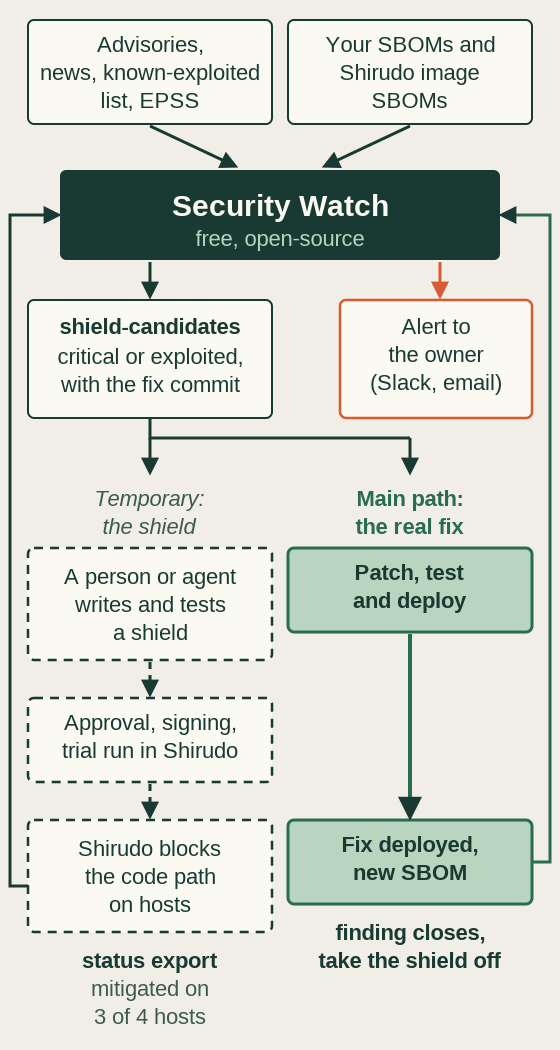
I build Security Watch, a free, open-source monitor you run yourself. It reads your lockfiles and SBOMs (the parts list of everything a system is built from), watches advisories and security news, and tells the owner of the affected system on Slack or email.
Version 1.3.0 came out the day after the announcement. An AI coding assistant did most of the typing and a second model reviewed it in three rounds. I spent the day reading diffs. One day was enough because Security Watch already read SBOMs and sent alerts. The new work was reading Shirudo's files and grading findings for shields.
I built the integration from Shirudo's documentation as it stood in November 2026 and tested it against files in Shirudo's format, not against a live deployment. Shirudo's tables may still change.
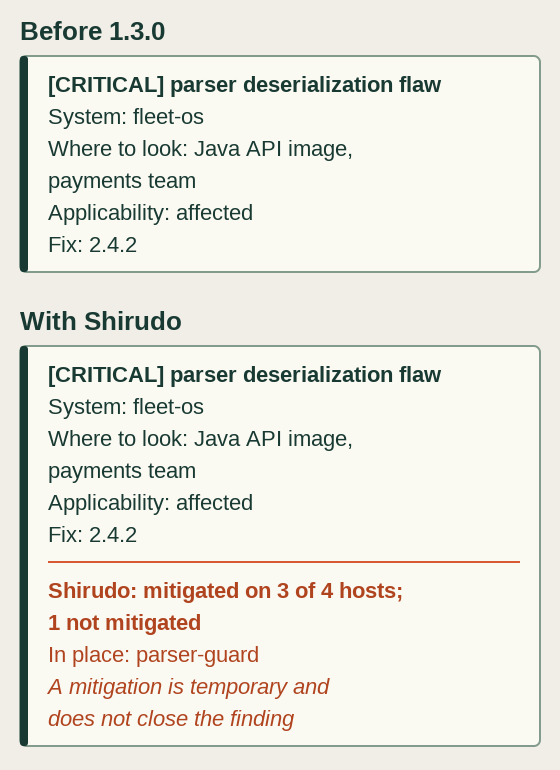
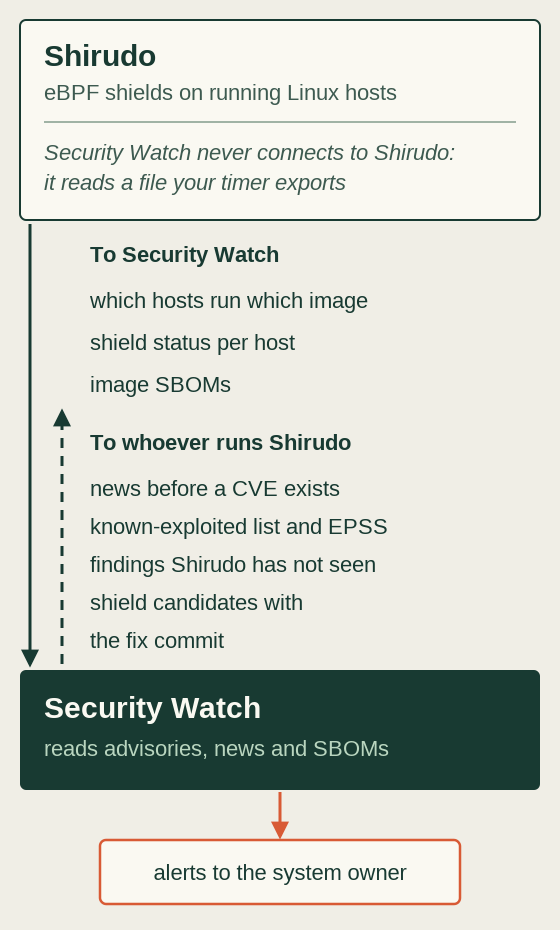
Shirudo knows which image each machine runs (a versioned build of its operating system and software) and, for each known vulnerability, whether a shield covers that machine. It keeps this in a ClickHouse table. You dump the table to a file every few minutes from cron or a systemd timer, using the query in the Shirudo guide, and Security Watch reads the file at each scan. Shirudo also keeps an SBOM for every image, and you sync those to a local folder. A new command, security-watch shirudo-sboms, picks out the ones for images your machines run, so Security Watch checks what is actually deployed. For both the status file and the SBOMs, Security Watch only reads files. It never connects to Shirudo or holds its credentials.
Here is what that does to an alert.
Shirudo finds vulnerabilities by matching its image SBOMs against an advisory database you refresh yourself. Anything that hasn't reached that database is invisible to it. Security Watch also reads security news, sometimes before a CVE (the public ID a vulnerability gets) exists. It follows CISA's Known Exploited Vulnerabilities list and EPSS, a daily estimate of how likely a bug is to be exploited.
So sometimes Security Watch knows about a problem that Shirudo doesn't. Then the alert says "Shirudo lists no such finding on the 4 hosts running this system". That's the cue for whoever runs Shirudo to add the advisory there or link a shield to it.
Security Watch only displays Shirudo's shield status. It never lowers a priority or closes a finding. A finding closes when a new SBOM or lockfile shows the fixed version. Other stopgaps, such as a web application firewall rule or a Tetragon policy (another eBPF tool that can block calls), go in a simple file you write, and each one can carry an expiry date. Once that date passes, Security Watch shows the mitigation as expired.
Why a news story can't write a shield
Monkhouse's sail had an advantage a shield doesn't. Nobody had to know exactly where the hole was. As Joseph Banks, the expedition's naturalist, put it in his journal, "where ever the leak was must be a great suction" that would pull the wool in. A shield sits on one function in one version of the code and rejects one kind of input, so someone has to find that function and that input first.
Say you read "X is being exploited" and you have an agent that writes shields. It's tempting to hand it the article. But an article rarely names the vulnerable function, and often not even the fixed version. An agent working from one is guessing, and a wrong guess can block real traffic on a production host.
A fix commit is much better. Its diff shows the vulnerable function, and if public exploit code exists, you can replay it against the shield before it blocks anything. Log4Shell is a good example. Its GitHub advisory links the pull request that fixed it. cve.now, one of the feeds Security Watch reads, lists exploit code for Log4Shell in all four exploit collections that cve.now tracks.
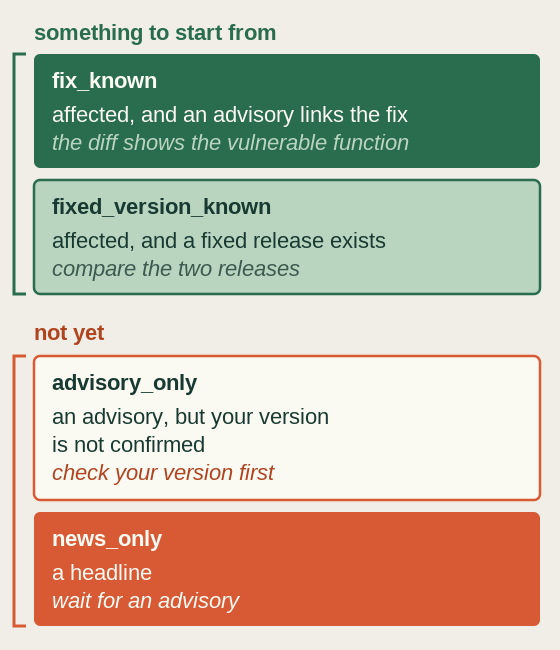
The new security-watch shield-candidates command lists your critical or exploited findings and grades how much is known about each one. The top grade, fix_known, means you're affected and an advisory links the fix. The bottom one, news_only, means all you have is a headline.
Security Watch doesn't write or deploy shields. A person or an agent writes them, and Shirudo's own process approves and signs them. I don't want my monitor anywhere near the step that can break a production host.
Mistakes I'd watch for
- Closing the ticket when the shield goes on.
- Shields with no end date and no owner. If your firewall has a rule called something like
temp-fix-DO-NOT-KEEP, check when it was added. - Writing a shield from a headline before any advisory names the vulnerable code.
- Letting the same agent write a shield and approve it.
Who takes the shield off
Nobody gets paged while a shield works, so the ticket for the real fix slides down the backlog a little every sprint. A year later the person who added the shield has moved teams, and nobody is sure the patch ever shipped.
So before a shield goes on, I want two answers written down: when it comes off, and who checks that the fix shipped. And I read "3 of 4 hosts mitigated" as "all 4 still need the patch, and one has no cover at all".
What happened to the guns
Endeavour left the river on 4 August 1770. The six guns stayed on the reef for almost two hundred years, until an American team with a magnetometer found them in 1969, crusted in coral. One is in the National Museum of Australia now. As far as I can find, nobody kept the sail.